Review: Revolutionary Headphones – The SleepPhones & RunPhones

3

As technology freaks and audiophiles, we have gone through probably a hundred different headphones. Many people use earphones every day. Yet if you were to ask them, or at least us, what is the one thing you just cannot stand about them, you are going to get an answer such similar to– ‘I hate the fact that they fall off easily’ or that ‘they do not fit in my ears quite securely’ or the worst ‘one side just stopped working!’ and most probably you have experienced that too.

Update: Acoustic Sheep is now launching an even better version of SleepPhones, with wireless charging and mic built in! For details, check out their Kick Starter Page!

Now, what if we were to tell you that there are earphones that fit securely, no matter how fast you are running, or even hanging upside down from a bar? And no, they aren’t bulky like those firearm noise protectors! This is what the RunPhones are all about. We tried them out and must say we were impressed with how well they fit. We ran, and jogged, hit the gym (which we should be doing more often) and engaged in various exercises, yet they did not fall off. The reason is that the headphones are hidden in a nice,comfy, moisture-wicking and washable headband. There are several different colours you can choose from too, like black, blue, lavender, orange and many more.

Win a Free SleepPhone or a RunPhone! For details, keep reading till the end of this article!

Another reason why we love the RunPhones is because they have been designed in a way that enables us to keep them clean easily too. They have a soft, washable mesh or fleece, and the speakers are removable. They are lightweight, yet durable, and their design is truly innovative. The wire is very long (4 feet) and sturdy, braided cord. Moreover they are eco-friendly. The company that manufactures these is called Acoustic Sheep, and they are RoHS compliant.

RunPhones are very safe too. Even though you will be hearing your favourite music, you will still be aware of the traffic around you while you are jogging or running.
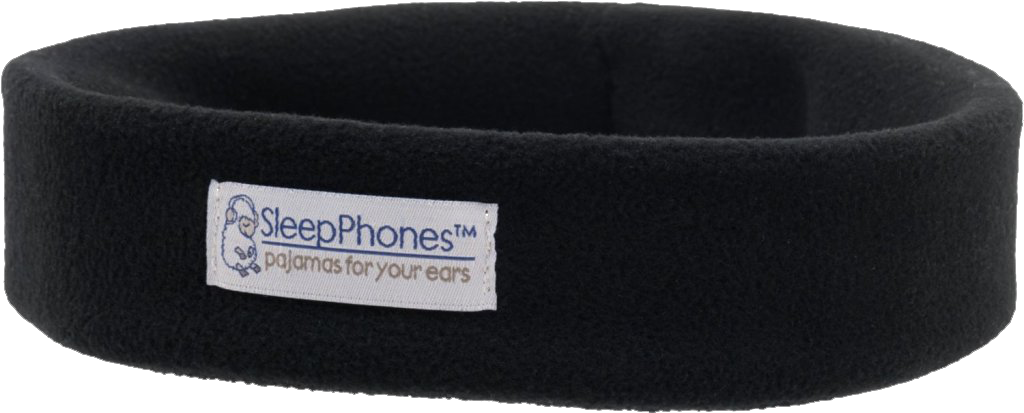
SleepPhones in blackRunPhones are not our most favourite headphones. They are our second most favourite ones. The top spot in our list goes to another product that the same company is producing, called the SleepPhones. Basically they are RunPhones without the cord. Yes, wireless, work via bluetooth. The speakers are embedded in a headband that is soft and comfortable to wear even while you are sleeping. (Duh, didn’t the name gave that away already?) They work well with most music players or smart phones and we must say we were impressed with their long battery life. We listened to an audiobook non-stop for 10 hours, and the headphones lasted around 13 hours on 1 single charge. It took us slightly less than 3 hours to fully charge them back again. Its a miracle how such a small device could last that long. The company states that they can work from a distance of up to 30 feet, but we weren’t that lucky. They worked great from 15 feet, but after that, the audio started getting jittery.
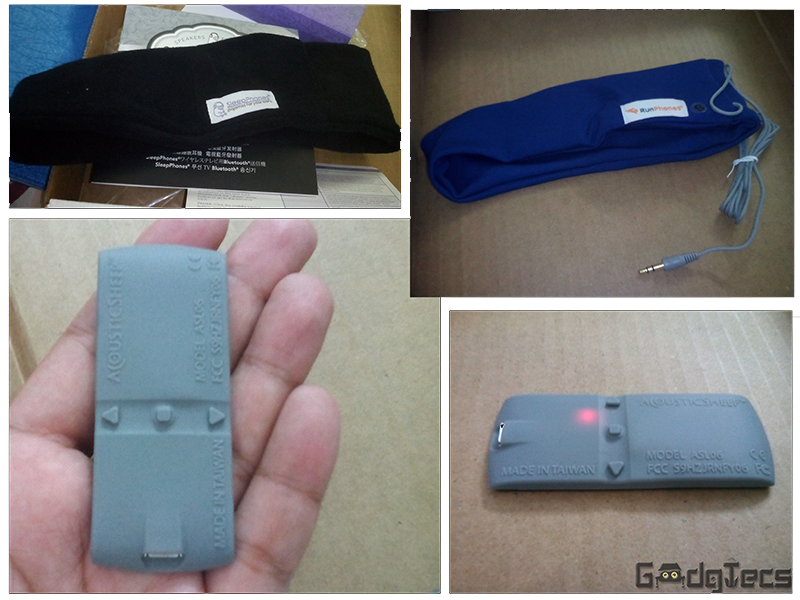
SleepPhone & RunPhones
From top left, clock wise: (i) Black SleepPhones with instruction booklet (ii) Blue RunPhones (iii) The think BT device inside SleepPhone turned on and (iv) BT device in hand

If your spouse or partner snores loudly and you have been having trouble falling asleep, then you should definitely try out SleepPhones. They block out all the snoring, and any other noise that might have otherwise disturbed your sleep. We Simply love their innovative design and there is no denying that this is a practical and effective idea for so many people who are deprived of a good night’s sleep because of snoring or other disturbances or noises. Thankfully, we didn’t have the snoring problem, but we do love listening to audiobooks while we sleep, so this is perfect. You can also listen to some soothing sleeping music, but that’s your choice. With traditional headphones, our ears used to get sore.
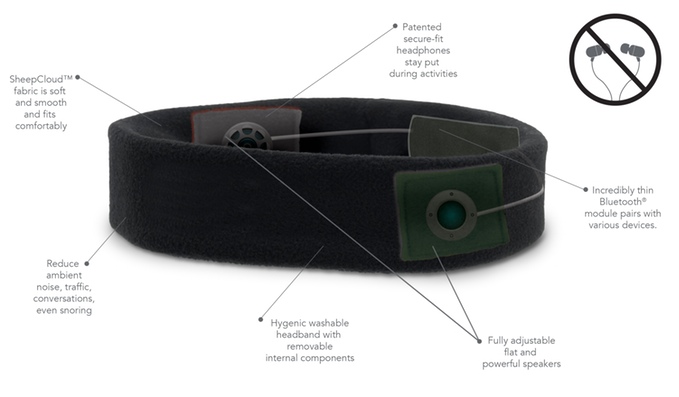
How do SleepPhones work
Source: SleepPhones.com

Designed by a doctor, both of these headphones are definitely the most innovative product in this line of business, as they solved so many problems in their own simple way. If you are looking for a cheaper option. the RunPhones are a must have. They retail for around $39. But since we hate wires (even if its a long & braided one), we definitely recommend the SleepPhones. A bit expensive, but well worth it. They can be bought for a little under $100. Multipurpose, excellent while exercising, great for listening to books or music if lying down. 5/5 stars without any hesitation.

Ok, time now for the good news. We got the headphones by the company to test for a review, and with their permission, we want to give away both ours to you! Yes, dear readers, you can now win (slightly used, like 20 hours or so, but professionally cleaned and repacked) either the RunPhones (in blue) or SleepPhones (in black). See below to enter the raffle. We’ll chose 2 winners, the lucky one will get the RunPhones and the luckier one would be getting SleepPhones for free! You can share the article and follow us on our social media using the widget below to increase your chances of winning. The contest is open worldwide to readers above the age of 13. (except Israel 🙁 Sorry, our country’s law don’t permit us to send or receive anything from there). We’ll be notifying the winners via email. We will NEVER use your email to send SPAM. In fact, we don’t even send ANY newsletters or subscription emails yet, and don’t plan to in the near future.

THANKS YOU for participating in the giveaway competition. We received 3300 entries from all over the world. We wish we could have given each one of you something!

Anyways, the winner (selected randomly using the Gleam.io app) are:

  • Joshua Craig (j*******@****.com) from Argentina (Winner of RunPhones)
  • Ali Raheemi (a*******@*******.fr) from France (Winner of SleepPhones)

Congratulations! The winners have been notified by email. In case we don’t get a reply within a week, we’ll select someone else. 🙂


Can Astronauts Propel Themselves Using Farts in Space?

1

Farts are an fascinating quirk of nature when you consider it. (Admit it: You’ve thought deeply about farts in your life, at some point in life). After all, we are basically speaking about a putrid gas that escapes out of your butthole on command. It sounds so sci-fi!

Farts. The butt of many immature jokes.

Flatulence is flammable—as everyone knows due to those YouTube videos stupid of people lighting their farts on fire. That’s because farts are made-up of methane (along with nitrogen, hydrogen, and carbon dioxide gases).

Considering farts are actually explosive: Is it possible to propel your self in space via some (or lots of) flatulence?

While this question could appear ridiculous to some, it is really something that scientists have considered. Seriously! In a Reddit AMA (ask me anything), gastronaut astronaut Chris Hadfield admitted to experimenting with astronaut fart propulsion. (I’m certain the Canadian Space Agency could not be more pleased with his extremely vital research).

reddit fart - wooden frame

Okay, so we all know that flatulence can’t exactly accelerate a human at great speeds, however that does not mean that we can’t theoretically harness the power of farts for propulsion.

“Flatulence would propel an astronaut ahead very slowly, however should you used the gas as fuel for a combustion reaction the astronaut may get going a lot faster,” says physics doctoral student Matt (Reddit user VeryLittle) in a post in Reddit’s science subreddit (group).

Farts are basically rocket fuel, however you would need tons and tons of it (much more than probably the most ravenous Taco Bell eater is able to produce in a lifetime) to propel your self via space by farting.

Interestingly, astronauts do fart more in space, however it’s not sufficient to generate any significant thrust.

According to a flatulence study (yes, scientists study that in detail too), a typical individual releases around 1 liter of gas per day. That’s roughly the same size as the water bottle below and Matt estimates that the fart would weigh around half a gram:

1 litre bottle

And he estimates that the velocity at which a fart leaves your butthole is around 1 meter per second.

To determine how far you would travel—assuming an average day’s farts—Matt put those numbers in this equation:

(1 m/s)(0.5 grams) = 0.0005 kg m/s

Basically, he concludes that you would barely move at all.

“The astronaut will now be traveling 7.7×10⁻⁶ m/s forward, which is only about a thousand times quicker than hair grows. If an astronaut in space farted each day, it will take ten thousand years for him to get up to a normal highway velocity.”

But if there was someway to harness the fart’s power, by exploding it backwards like a rocket to push you ahead, then the astronaut may theoretically reach much higher speeds:

methane cow collection
Methane from Cows’ is collected in pink bags, to be used elsewhere later

“If we had one of those fancy gas backpacks that they put on cows to harvest the methane from their farts and a jetpack to burn it, then this gasoline could be sufficient to get a very flatulent astronaut up to highway velocity in a day.”

farting cow jet
Ready for takeoff

Siri & Google Now Can Be Hacked From 16 Feet Away

Google Now may be your personal assistant. However your voice isn’t the only one it listens to. As a group of researchers from France have found, Siri & Google Now also helpfully obeys the orders of any hacker who talks to them—even, in some instances, one who’s silently transmitting instructions through radio from so far as sixteen feet away.

A couple of researchers at ANSSI, a French government agency dedicated to information security, have proven that they can use radio waves to silently set off voice instructions on any Android cellphone or iPhone that has Google Now or Siri enabled, if it additionally has a pair of headphones with a microphone plugged into its jack. This intelligent hack makes use of these headphones’ wire as an antenna, exploiting its wire to transform surreptitious electromagnetic waves into electrical signals that seem to the smartphone’s operating system to be audio coming from the user’s mic. With out speaking a word, a hacker may use that radio attack to ask Siri or Google Now to make calls and send messages, dial the hacker’s number to turn the cellphone into an eavesdropping gadget, send the smartphone’s browser to a malware website, or ship spam and phishing messages through e-mail, Facebook, G+ or Twitter etc.

The possibility of inducing parasitic signals on the audio front-end of voice-command-capable units might raise crucial security impacts,” the 2 French researchers, José Lopes Esteves and Chaouki Kasmi, write in a paper published by the IEEE. Or as Vincent Strubel, the director of their research group at ANSSI puts it more simply, “The sky is the limit here. Every thing you can do via the voice interface you can do remotely and discreetly via electromagnetic waves.”

Hacking via Radio
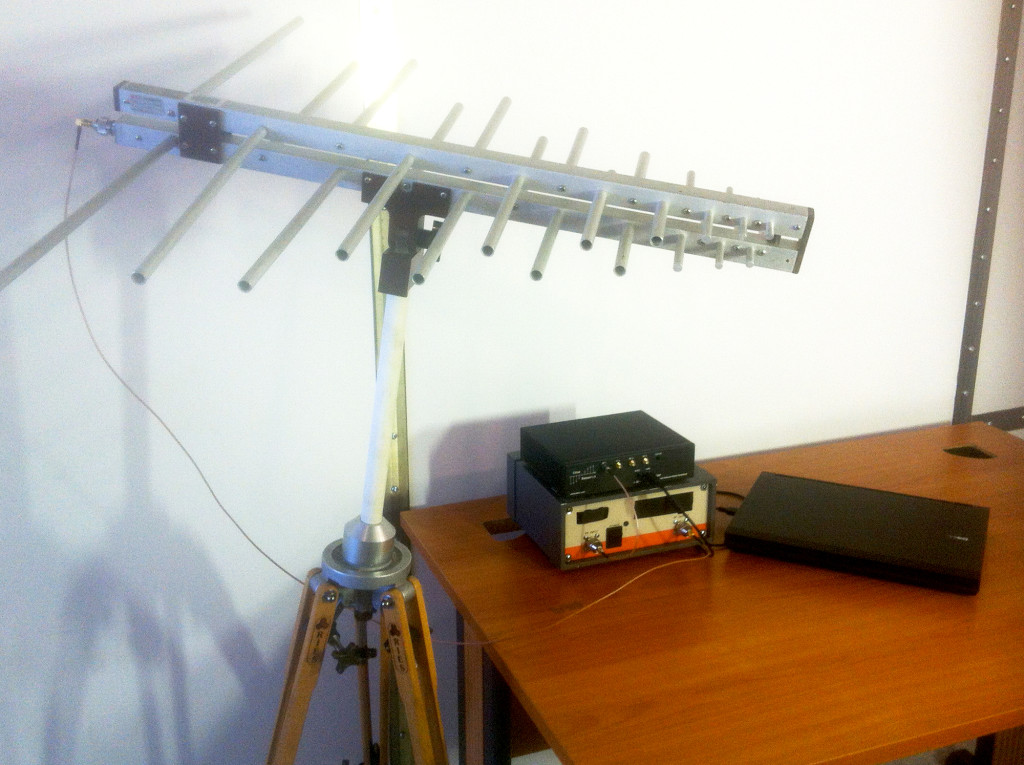
The experimental setup Esteves & Kasmi used to hack with radio waves. © José Lopes Esteves

The researchers’ work, which was first presented at the ‘Hack in Paris’ convention over the summer but received little notice outside of some French web sites, makes use of a relatively easy collection of equipment: It generates its electromagnetic waves with a laptop operating the open-source software GNU Radio, a USRP software-defined radio, an antenna, and an amplifier. In its smallest form, which the researchers say may fit inside a backpack, their setup has a range of around 6.5ft. In a more powerful form that requires bigger batteries and could only practically fit inside a car or a van, the researchers say they may extend the attack’s range to more than 16ft.

Here’s a video exhibiting the attack in action: In the demo, the researchers commandeer Google Now through radio on an Android smartphone and force the smartphone’s browser to visit the ANSSI site. (That experiment was carried out inside a radio-wave-blocking Faraday cage, the researchers say, to abide by French laws that forbid broadcasting certain electromagnetic frequencies. However Kasmi and Esteves say that the Faraday cage wasn’t essential for the hack to work.)

The researchers’ silent voice command hack has some critical limitations: It only works on smartphones which have microphone-enabled headphones or handsfree plugged into them. Many Android phones don’t have Google Now enabled from their lockscreen, or have it set to only respond to instructions when it recognizes the user’s voice. (On iPhones, nevertheless, Siri is enabled from the lockscreen by default, with no such voice identity feature.) Another limitation is that attentive victims would likely be able to see that the cellphone was receiving mysterious voice commands and cancel them before their attack was complete.

Then again, the researchers contend that a hacker could disguise the radio gadget inside a backpack in a crowded area and use it to transmit voice instructions to all the surrounding smartphones, many of which might be vulnerable and hidden in victims’ pockets or purses. “You can imagine a bar or an airport where there are many people,” says Strubel. “Sending out some electromagnetic waves might trigger a lot of phones to call a paid number and generate money.” 

Although the latest version of iOS now has a hands-free feature that permits iPhone owners to send voice commands merely by saying “Hey Siri,” Kasmi and Esteves say that their attack works on older versions of the operating system as well. iPhone headphones have long had a button on their wire that enables the person to enable Siri with a long press. By reverse engineering and spoofing the electrical signal of that button press, their radio attack can set off Siri from the lockscreen with no interaction from the user. “It is not necessary to have an always-on voice interface,” says Kasmi. “It does not make the smartphone more vulnerable, it simply makes the attack less complex.”

Of course, security conscious phone users probably already know that leaving Siri or Google Now enabled on their smartphone’s login screen represents a security risk. At least in Apple’s case, anybody who gets hands-on access to the device has long been able to use these voice command features to squeeze sensitive info out of the smartphone—from contacts to recent calls—and even hijack social media accounts. However the radio attack extends the range and stealth of that intrusion, making it all the more important for customers to disable voice command functions from their lock screen.

The ANSSI researchers say they’ve contacted Apple and Google about their work and recommended different fixes, too: They advise that better shielding on headphone cords would force attackers to use a better-power radio signal, for example, or an electromagnetic sensor within the smartphone might block the attack. However they note that their attack may be prevented in software, too, by letting customers create their very own custom “wake” phrases that launch Siri or Google Now, or by utilizing voice recognition to block out strangers’ commands.

With out the security measures Esteves and Kasmi suggest, any phone’s voice features may represent a security liability—whether from an attacker with the smartphone in hand or one that’s hidden in the next room. “To use a smartphone’s keyboard you have to enter a PIN code. But the voice interface is listening all the time with no authentication required,” says Strubel. “That’s the primary issue here and the goal of this paper: to point out these failings within the security model.”

A USB that can literally destroy your computer!

3

USB sticks have long been a mechanism for delivering malware to unsuspecting computer users. A booby-trapped flash drive, for example, was the means by which the US and Israel reportedly contaminated Iran’s Natanz uranium enrichment facility with the Stuxnet worm. And, in case anybody thought USB stick attacks had lost their novelty, last year’s Bad USB proof-of-concept exploit delivered a highly programmable attack platform that can’t be detected by today’s defenses.

Now, a researcher who goes by the identify Dark Purple has created a USB stick  that completely destroys a lot of the computer’s actual hardware circuits, rendering the machine little more than an expensive doorstop. Within a couple of seconds after being plugged in, the USB stick delivers a negative 220-volt electrical surge into the USB port.  😯 Negative because usually most chips inside a computer have over-voltage or surge protection for positive voltages. As the video below demonstrates, that is sufficient to permanently damage the IBM’s Thinkpad Laptop receiving the shock.

[rev_slider usb-x]


As you can see, the USB stick seems like a regular thumb drive, and there aren’t any outward indicators it is malicious. However the USB Killer 2.0, as its creator calls it, takes computer attacks on a much less-traveled highway that results in physical destruction. Based on this post from The Daily Mail, an earlier and less powerful model of the USB device drew power from USB ports utilizing a DC-to-DC converter until it reached negative one hundred volts. At that point, the power was directed into the pc. The process ran on a loop till the circuitry failed. It is very likely that Version 2.0 works in a similar fashion.

It isn’t clear from Dark Purple’s blog post exactly how far the damage from the updated gadget extends. Using Google Translation (since the original blog is in Russian), we can infer that the USB port is fried, and it isn’t shocking that circuits on the motherboard had been burnt, as well. The I/O controller hub has also passed away. The hard drive and CPU, however, have a greater probability of surviving, though that is not clear from the demo, either. In any event, the video is another reason to be cautious of USB devices, especially those that come from unknown or shady sources.

Spy Planes, Signal Jammers, and High-Tech Weapons in Syria

The relationship between Russia and the West is becoming increasingly dangerous with potential flashpoints developing in both eastern Europe and Syria. After repeated incursions into Turkish airspace by Russian warplanes on bombing raids over Syria, NATO’s secretary general Jens Stoltenberg warned Moscow that it stands ready to “defend all allies”. In the meantime Britain announced it will ship troops to Baltic states to defend NATO’s eastern boundaries against potential Russian aggression beyond Ukraine.

 The Krasukha-4 is a broad-band multi-functional jamming system designed to neutralize Low-Earth Orbit (LEO) spy satellites such as the US Lacrosse/Onyx series, airborne surveillance radars and radar-guided ordinance at ranges between 150km to 300km. The system is reported to have the ability to cause damage to the enemy’s EW systems and communications. The Krasukha-4 system works by creating highly effective jamming at the fundamental radar frequencies and different radio-emitting sources.

In recent weeks, Russia has also deployed the IL-20 surveillance plane, better recognized by its NATO title “Coot” and roughly equal to the U.S. Navy’s P-3 Orion, a mainstay of the Pentagon’s spy tools. The Russian aircraft is bristling with high-tech equipment like surveillance radar, electronic eavesdropping gear, and optical and infrared sensors. One of the Kremlin’s premier spy planes, it offers Russian forces with a powerful tool for finding rebel units and assigning targets to its fighter planes. In late September, Syrian rebels posted a video purporting to show the aircraft flying over a battlefield.

https://www.youtube.com/watch?v=9qwNY9GFXp8

The deployment of the IL-20, or Coot, is probably the clearest indication that Russian President Vladimir Putin wants to ensure his troops in Syria aren’t reliant on Assad’s forces for targeting info — and that they could be getting ready for a ground combat position. On Monday, Moscow said “volunteer” troops could be heading to Syria to join the battle there, a barely disguised sign that Russian forces might soon be directly battling U.S.-backed and trained rebels inside Syria.

Coot or IL-20
The ‘Coot’ or the Ilyushin Il-20 (IL-20) – Source: theaviationist.com

Russia’s transfer of advanced electronic warfare tools to Syria is the latest instance of Moscow’s so-called “hybrid warfare” tactics, which use deception and covert operations to achieve strategic objectives with a minimal use of military force. The Krasukha-4 was also noticed in Ukraine and played a key part in Russia’s campaign of electric warfare there, which Kiev claimed resulted in a disruption of cell service at times. The deployment of the Krasukha, which can be utilized to disable aircraft avionics, came at around the same time that Western policymakers publicly entertained the idea of creating a no-fly zone over eastern Ukraine. The positioning of the Krasukha, along with other air defenses, prevented the enforcement of such a no-fly zone and kept Kremlin in charge of the skies, according to Igor Sutyagin, a senior research fellow at the Royal United Services Institute, a London based think tank.

Now, too, the Krasukha has been put in place as several countries are calling for the establishment of a no-fly zone in northern Syria. Sutyagin described the deployment of the Krasukha as an effective “no-fly zone for those who wish to create a no-fly zone.” For now, there isn’t any proof that the electronic warfare system has been used against American and other coalition planes flying in the skies over Syria, however its presence has surely been noted by the Americans.

The usage of cutting-edge signals intelligence and electronic warfare tools is indicative of Russian intentions in Syria. Jeffrey White, a fellow at the Washington Institute for Near East Policy and a 34-year veteran of the U.S. Defense Intelligence Agency, described the rebels as not “that hard a SIGINT target,” utilizing a shorthand term for signals intelligence, or transmissions plucked off the airwaves. “Do [the Russians] want their best and most sophisticated collection techniques and methods?”

Russia’s use of the new tools — particularly the equipment designed to provide more precise targeting data — comes amid a fierce debate between Russian and the American administration over Russia’s true targets in its Syria air war. Russian leaders insist they’re only hitting targets tied to the Islamic State, however rebel groups in the country — backed by senior U.S. officers like Defense Secretary Ash Carter — say Moscow is actually dropping virtually all of its ordnance in areas held by groups combating Assad.

Russia and Syria have a long history of intelligence cooperation in the fight against the country’s rebels, and Russia has previously provided alerts intelligence expertise to the Syrian authorities. In October 2014, rebels overran a Syrian military base close to the Golan Heights, discovered a joint Russian-Syrian listening post, and posted a video tour of the secretive facility.

Asked in regards to the intensified Russian intelligence buildup in Syria, one U.S. senior defense official remained closed-lipped about Moscow’s capabilities there apart from acknowledging the sophisticated instruments at Russian troops’ disposal and that “their operational patterns remain the same” as in Ukraine. Speaking on condition of anonymity to discuss classified details, the official stated that Russia has concealed communications and movements as it did in Ukraine, including by hiding Russian fighter jets within the signature of larger cargo jets.

R-166-0.5
R-166-0.5 Signals Vehicle

Other assets deployed to Syria include the R-166-0.5 signals vehicle, which provides command and control functions for a battalion of Russian ground troops. Its presence in Syria is intriguing, Sutyagin stated, because it implies the presence of a battalion-strength detachment of ground troops. On Monday, Interfax reported that the Vasily Tatishchev, an advanced naval surveillance ship, has sailed for the eastern Mediterranean.

R-330P
The R-330P

Earlier this summer, military blogs reported that the Syrian military had obtained from Russia a brand new batch of R-330P communication jammers. The simple radio communications tools utilized by anti-Assad rebels are simple fodder for such a system and could be used to undermine coordination by insurgent forces in mounting operations and offensives.

Between the Krasukha, the IL-20, and the Vasily Tatishchev — along with the reported presence of surveillance drones — Russia has poured its best assets into Syria against targets that really shouldn’t be particularly hard for the country’s air force to hit. However that deployment is still quite small, and its concentrated use has allowed Putin to achieve his objectives with a minimal amount of effort.

Hi-Tech All The Way

Since the starting of the Arab Spring, NATO countries led by the US and directly supported by the UK have been actively gathering intelligence from countries using EW assets together with low-orbit surveillance satellites (Lacrosse/Onyx series), reconnaissance planes (NATO E3 Sentry (AWACS), USAF RC135-Rivet Joint, RAF’s Sentinel R1 and Reaper drones), and sharing intelligence data with the side being supported in the battle.

Sentinel_R1_MOD
Sentinel R1 – Source: Wikimedia Commons

Since the land grab by the self-proclaimed Islamic State (IS) in both Iraq and Syria, NATO’s EW assets have been targeting IS insurgents fighting units, gathering intelligence to offer tactical target info and to actively engage IS by denying rebel units radio communication and surveillance information – thus electronically blinding them. Sanitized intelligence information is shared with friendly forces including the rebel forces fighting against Syrian president Bashar al-Assad.

Until September 2015, Russia has been supporting Assad by supplying arms and training to Syrian forces. Bolstered by what it sees as Western indecisiveness on a Syria solution and by the West’s inaction on Russia’s military intervention in the Ukraine, Russia has decided to provide direct military air support to Syria. Nonetheless, Assad’s enemies comprise all rebel groups opposing his rule – not just IS.

The Cat & Mouse

So how can the Krasukha-4 be used to cloak Russia’s operations in Syria? In words – partially effectively. Its surveillance techniques won’t only be able to monitor NATO airplanes movement over Syria but also the types, and from its intelligence it’ll know the frequencies used and signal characteristics present – Lacrosse satellites and AWACS operate in S-band, Sentinel (and similar) in X-band, and drones in J-band. Lacrosse/Onyx satellite positions are regularly tracked by Russia. With this intelligence detail the Krasukha-4 could be programmed to engage so as to deny or disrupt NATO intelligence gathering.

lacrosse
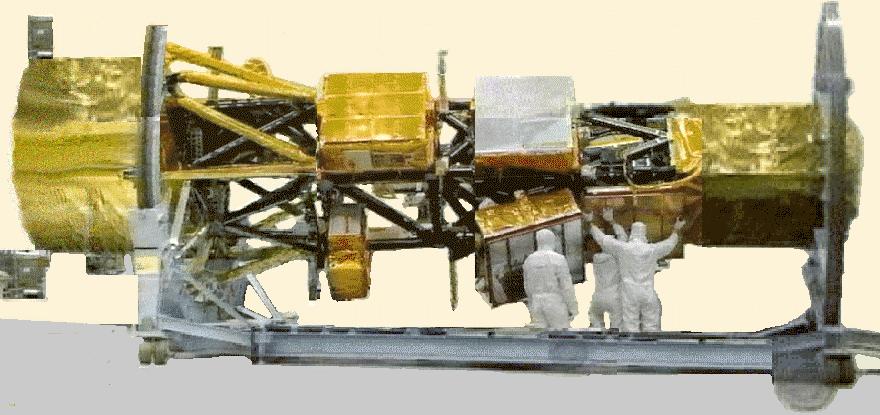
Lacrosse Satellite – A small surveillance satellite – Source: Globalsecurity.com

However it isn’t all one way – US and NATO intelligence gatherers will have “electronic counter counter measures” (ECCM) to fight Russian EW interference – and so the cat and mouse game of the Cold War is repeated. Intelligence gathering and radar-guided munitions will suffer some disruption and errors may be made however operations will continue.

ECCM might include being frequency agile and dodging the jamming signal or pointing the receiving antenna away slightly from the jamming source. There are additionally many methods that may be played with signal processing that can mitigate the effects of jamming. After all, it might even be possible for NATO to jam the Russian surveillance radar, denying them of identification and positioning of NATO planes – but this may really ramp up the confrontation with Vladimir Putin.

Russia will now be able to test its new EW techniques in live combat but avoiding direct conflict with NATO – it’ll improve overseas sales prospects of the Krasukha-4 system. NATO shall be in a position to test its ECCM against another EW system, presumably with similar ends in mind.

With a handful of fighter jets, just a few naval assets, a jammer, and a signals intelligence aircraft, Putin has managed to reshape the balance of power in Syria. It’s what Sutyagin, who spent 11 years in jail in Russia on flimsy espionage charges that brought on human rights groups to label him a political prisoner, called an enormous achievement “with tiny efforts.”

Tags: turkish log jammer, russian military, future power weapons

American Capital Harnessing Electrical Energy From Each Flush

2

The next time you flush in the capital of United States, you may think about this: You — or, more precisely, when ever anyone flushes — will assist in generating clean energy.

D.C. Water, which also treats sewage from much of the Maryland and Northern Virginia suburbs, recently became the first utility in North America to make use of a Norwegian thermal hydrolysis system to transform the sludge left over from treated sewage into electrical energy.

Yes, to put it bluntly, the city’s sewage treatment plant is turning poop into power.

“It is an enormous deal on so many fronts,” D.C. Water General Manager George S. Hawkins stated after Wednesday’s official unveiling of the system. “It’s a public utility leading the world in innovation and technology. We have private and public water firms coming from all around the world to see this.”

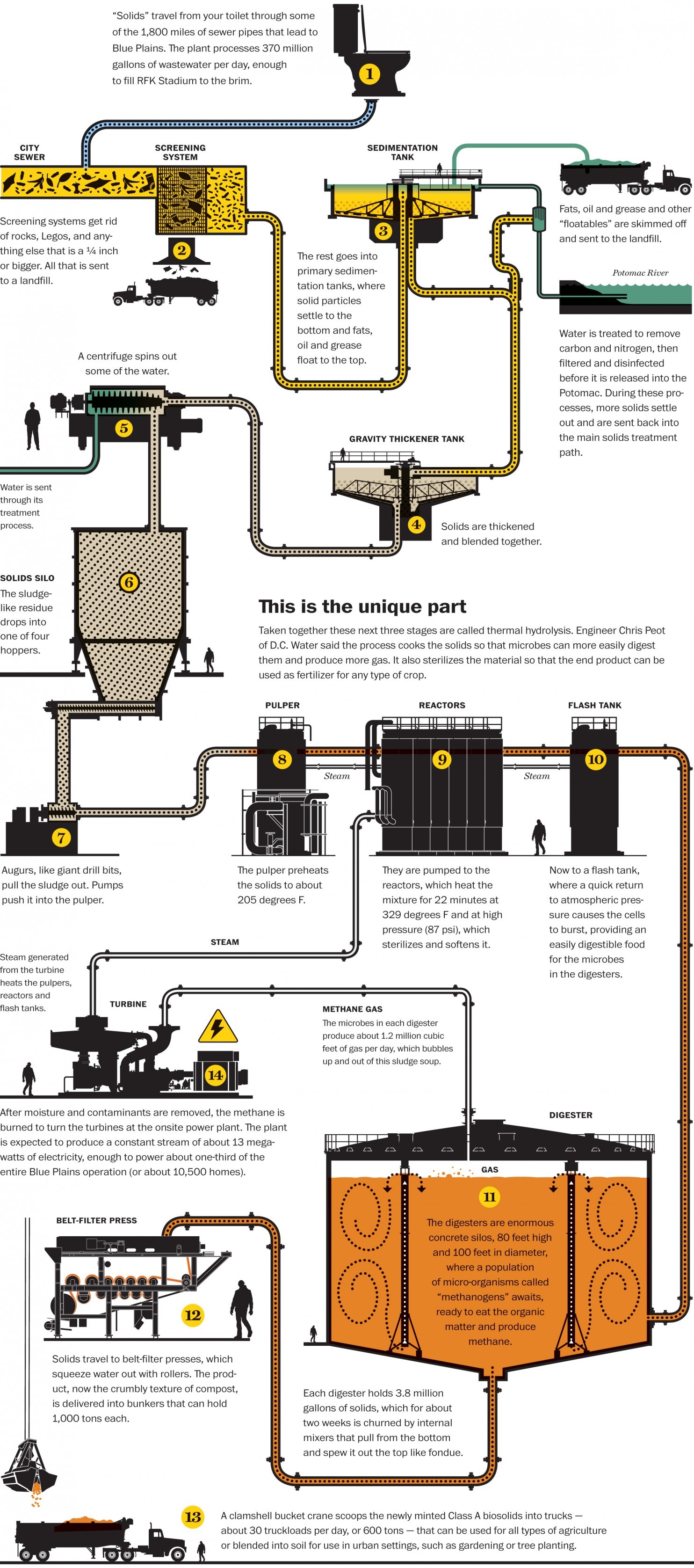
How Poop is turned into electricity - click for the complete image
How sewage is turned into electricity – click for the complete detailed image

However the Blue Plains Advanced Wastewater Treatment Plant, officials say, is the first in North America to do so using “pressure cooker” technology that can fit such a system in the relatively tight confines of an urban treatment plant. D.C. Water officials say it’s the biggest of its type on the planet.

Hawkins mentioned the system, which started producing electricity in September, will provide one-third of the 157-acre plant’s power, saving about $10 million yearly. Huge amounts of water and sewage need lots of energy to move via pipes and pumps, making D.C. Water the city’s largest consumer of electricity.

The utility expects to save an extra $2 million or so yearly on treatment chemicals and $11 million yearly in trucking expenses. Previously, the plant produced 1,200 tons of “Class B” biosolids every day, the industry term for the darkish gunk left over from treated sewage. That moist, smelly residue needed to be carried away in 60 truckloads every single day, traveling about seventy five miles to farms in Virginia. The new system produces about half as much of a cleaner “Class A” biosolid, which requires half the number of truck runs and smells less like poop and more like damp mulch.

The Class A compost-like substance may show up within the next year on the shelves of Home Depot as a soil nutrient for home gardens, officials said.

D.C. Water officials say the $470 million system, which took 4 years to construct, will end up paying for itself and shrink the plant’s overall carbon footprint by one-third.

At the dedication ceremony, officials from the U.S. Environmental Protection Agency and the U.S. Energy Department touted the system as an example of how localities can invest in infrastructure while conserving energy and cleaning the environment. Officials noted that water & sewer utilities account for 4% of the nation’s overall power usage, making them the biggest energy consumers in most communities.

D.C. Mayor Muriel E. Bowser (D) said the system dovetails with the city’s sustainability efforts.

“We can not afford to have waste be just waste,” Bowser stated. “Every dollar spent to transform that waste into energy will help us to reach our goals.”

Here’s the way it works: Once you flush or send soapsuds down the drain, the contents travel via miles of pipe and finally reach Blue Plains, off Interstate 295 in Southwest Washington . There, what appears like brown, murky water flows by screens that remove debris and then sits to allow solids to settle. Then, enormous centrifuges spin off the water and focus the remaining poopy solids.

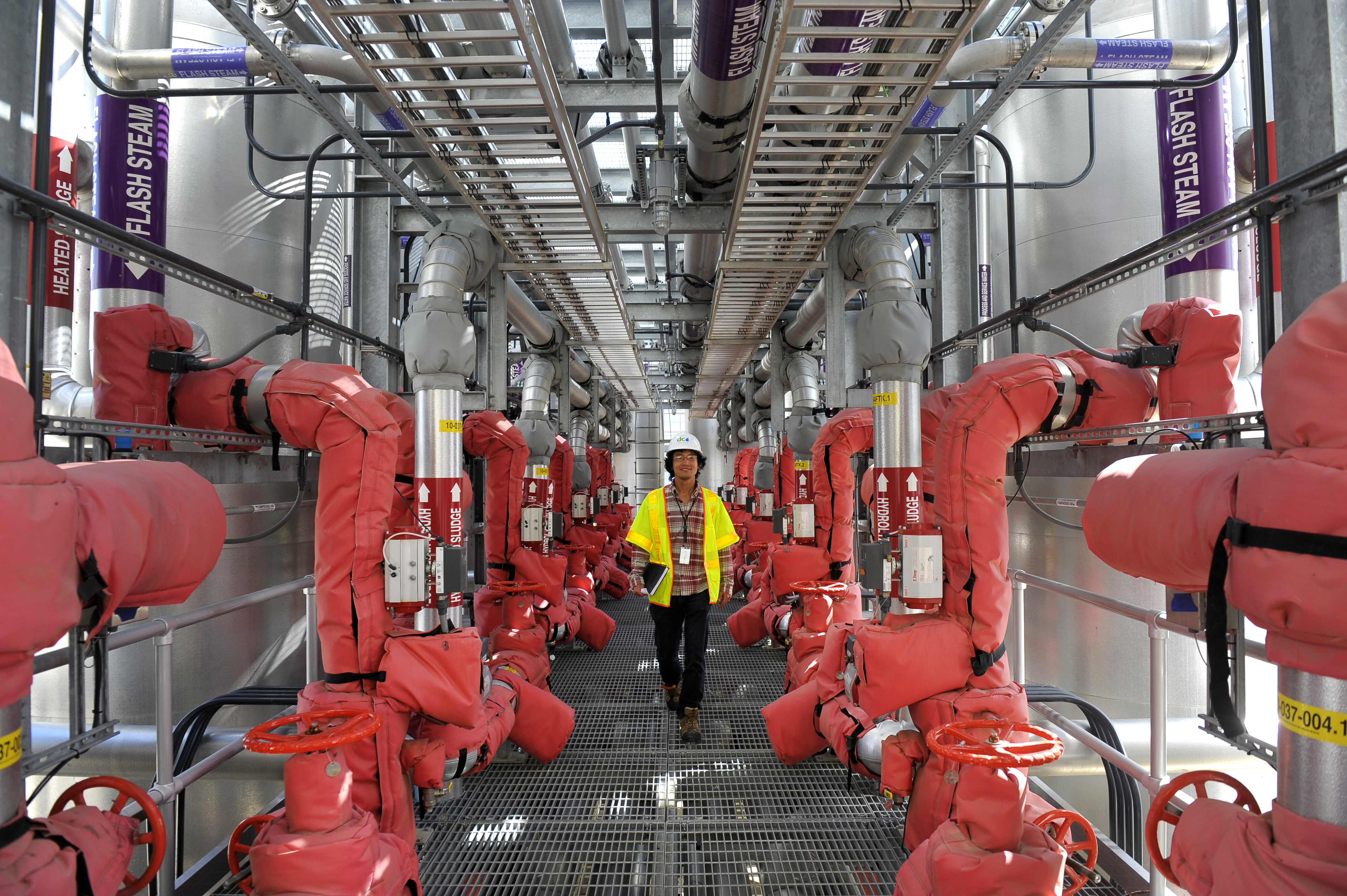
The liquid is sent off to be treated after which it returned to the Potomac River (yuck! and we thought only astronauts drank water purified from the piss), and the concentrated sludge is pumped into massive steel Cambi reactors, named for the Norwegian manufacturer. The reactors perform like pressure cookers, using 338-degree steam and pressure to cook the sludge. Then it gets pumped to another tank at a much lower pressure, which causes the cell walls of the unhealthful pathogens and other microbes to burst.

“We are not just burning up the bacteria,” Hawkins explained. “We completely destroy it.”

The sludge is then despatched into one of 4 “digesters” — concrete cylinder tanks as tall as eight-story buildings — that each hold 3.8 million gallons. There, it spends about three weeks as microbial bugs nibble at it. The bugs convert the organic matter into methane gas, which is cleaned and sent to a close-by building, where generators burn the methane gas and produce electricity. The entire system covers about 5 acres.

The key, Hawkins stated, is the Cambi pressure cookers that burn off a lot of the sludge, leaving less of it to be treated. That allowed D.C. Water to have only 4 monumental cylinder-like digester buildings instead of eight, which it didn’t have room for.

Hawkins lauded the group of local leaders for their support, saying that they and D.C. Water customers had made the venture possible.

A Router Virus That Actually Keeps You Safe!

Routers are amongst the most hackable devices connected to the internet — not often updated, easily compromised, and virtually never scanned for viruses. However a new router virus may actually be making the units safer, based on a report from the security firm Symantec. Dubbed Linux.Wifatch, the bug behaves like an everyday virus from the outside: infecting the system, operating undetected, and coordinating actions via a peer-to-peer network. However instead of performing DDoS assaults or on the lookout for sensitive information, Wifatch’s acts like a vigilante and its primary function appears to be protection from other malwares and viruses out there. It stays updated on virus definitions by way of its peer-to-peer network, deletes any spyware found, and cuts off different channels malware would usually use to attack the router. In short, Wifatch is actually defending its victims!

“To any NSA or FBI agents reading this: please consider whether defending the US constitution against all enemies, international or domestic, requires you to follow Snowden’s example.”

Most of Wifatch’s code is written in the Perl programming language and it targets several architectures and ships its own static Perl interpreter for each of them. Once a device is infected with the Wifatch, it connects to a peer-to-peer network that is used to distribute threat updates.

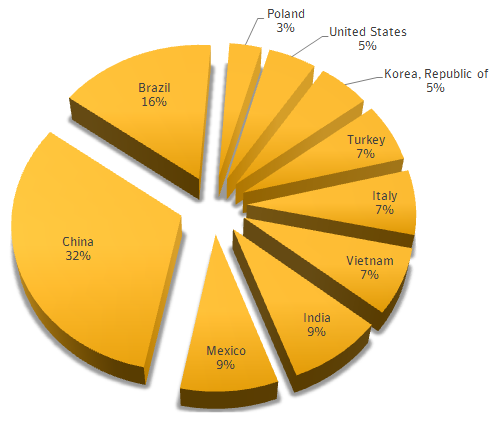
Breakdown of countries virus has infected
Breakdown of countries the virus has infected – Source: Symantec

It is still unclear where Wifatch comes from or why it was created, nevertheless it appears to be completely different from the typical virus. First discovered in 2014, the virus appears to make little effort to hide itself, and leaves numerous benign messages in its code. One, triggered when a person tries to access the Telnet, reminds users to update the machine’s firmware. Another, dropped as a comment in the source code, repeats a statement from free-software activist Richard Stallman: “To any NSA or FBI agents reading this: please consider whether defending the US constitution against all enemies, international or domestic, requires you to follow Snowden’s example.”

wifatch message
Wifatch message when a user tries to access telnet

Symantec estimates “somewhere within the order of tens of thousands of devices” are contaminated with the virus, with infections largely centered in Brazil, China, and Mexico. Resetting the router is enough to remove the virus, however the firm warns that a router might become reinfected over time. “Symantec will be keeping a close eye on Linux.Wifatch and the actions of its mysterious creator,” the post concludes. “Customers are suggested to keep their system’s software and firmware updated.”

Weekly Science News: 25th September – 2nd October, 2015

1

News: Brief Updates from the world of science for the week from 25th September 2015 to 2nd October 2015.

This week in #Science – 25th September to 2nd October

A photo posted by GadgTecs (@gadgtec) on

Reviews: The E-Blade Self Balance Board

8

In recent months, the popularity of the self-balance scooter (or the Segway hoverboard as the cool kids call them) has exploded with an array of celebs including the Biebs, Brooklyn Beckham, and even a Kardashian ditching their boots and heels for motors and wheels.

brooklyn-beckham-segway-board The eblade self-balance board is powered by two gyroscopic motors that use similar technology found in the original Segway but in a much more compact package. The inbuilt gyros maintain a level platform for the rider who controls the scooter by leaning on the smart pedal pads under each foot. The pedals are highly sensitive and require only the slightest of movements to propel the rider in any direction.

#tricks like #skateboarding plus it pushes uphill for you! #paddlingout

A post shared by eblade (@eblade_official) on

The scooters have attracted the “hoverboard” title from the public as they make the rider look like they’re floating. The effortless appearance of using the scooter only takes a few minutes to achieve as the rider becomes accustomed to the controls. Most users pick it up in around ten minutes and have it clocked in half an hour. The main thing to remember when riding is to let the scooter do all the work and try and keep your body in an upright position. Once you’ve got that thought cemented in your brain, it doesn’t take long before you’re zooming around the neighbourhood.

Eblade Smart Balance Board Specs

  • Charge time: 2-3 hours
  • Distance per charge: 25km (15.5 miles)
  • Max speed: 12km/h (7.5 mph)
  • Weight: 11kg (24 pounds)
  • Built-in Bluetooth speakers
  • Samsung lithium ion battery
  • Price: $799 AUD (561 US$ at the time* of posting)
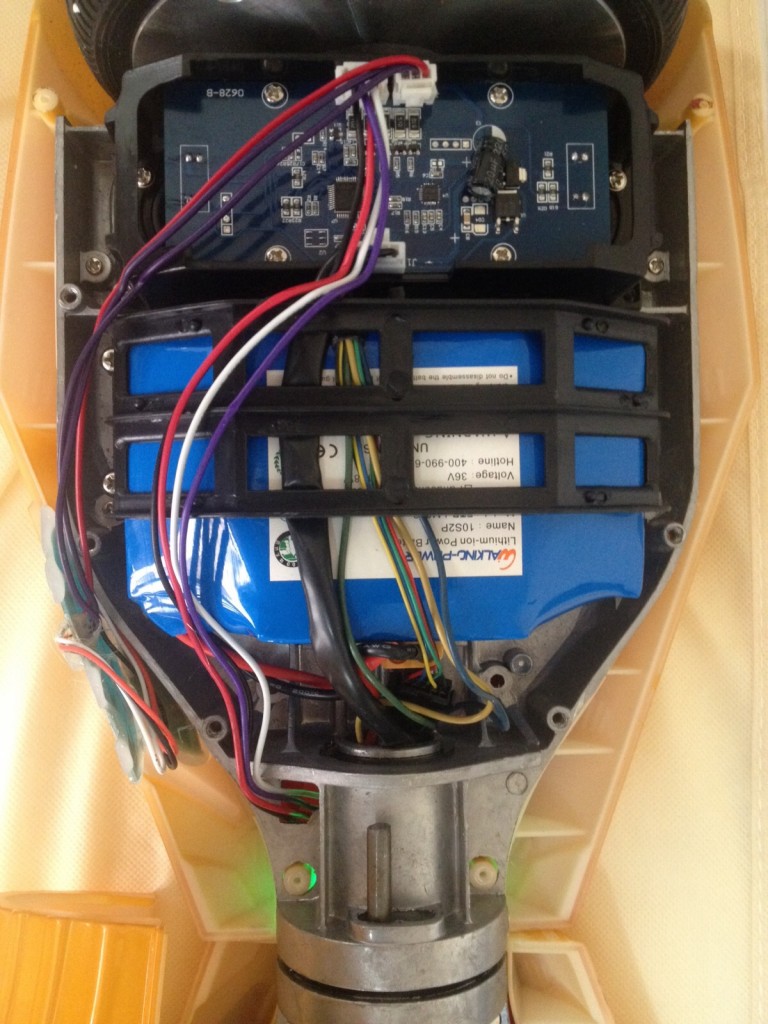
inside of an e-blade
Inside of an E-blade: very well built with a large battery

How practical the eblade scooter will be as an alternative mode of transport remains to be seen as it may take a while before the public adopt the scooter as a legitimate form of transport. But if you take into account the growing cost of owning a car in many countries, as well as the rising costs of public transport; the eblade scooter does become a more viable and eco-friendly option. The rechargeable Samsung lithium ion batteries are capable of supporting a 25km range which means workers who live close to the city can easily commute to work and back on a single charge, reducing the amount of cars on the road and also saving on parking!

Apart from the practical side of the scooter, these things are unbelievably fun to ride, turning every road and footpath into an adventure as you cruise through the once mundane city streets. The scooter also comes with built-in Bluetooth speakers so you can pump out your favourite tunes as you cruise.

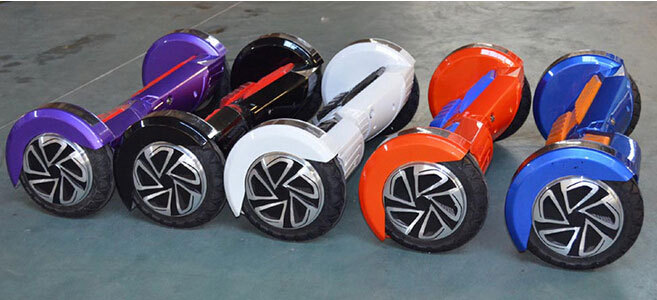
mini segway range

The eblade balance board is an absolute blast, and more practical than you think! So if you’ve got some spare cash and want a new way to get around the city why not add this to your Christmas list!

*30th September 2015

Scientists have found a new way to edit DNA

3

A FEW years in the past, molecular biologists made an enormous breakthrough. By borrowing an antiviral mechanism from bacteria, they created a simple method to tweak the genetic data inside cells – a method that had huge implications for science, medicine & agriculture. However, a dispute over who precisely invented what first has threatened to curtail its potential. But CRISPR-Cas9, as the disputed technique is known as, turns out to not be the only means bacteria defend themselves from the attentions of viruses.Recently, in Cell, a group of researchers led by Feng Zhang of the Broad Institute in Cambridge, Massachusetts, who is among the parties to the patent dispute, have announced their discovery of another such mechanism.

Like its predecessor, the new mechanism, called CRISPR-Cpf1, has the potential to turn into a tool that may deal with intractable genetic diseases such as Huntington’s, and degenerative conditions like Alzheimer’s. It may also be used to create new classes of anti-viral treatment, and thus curb infectious disease. Plant and animal breeders, as well as doctors, might find it helpful, too. They could create new strains of crops and livestock. Indeed, because, like CRISPR-Cas9, it doesn’t involve taking genes from one organism and implanting them in another, it is not going to count as “transgenic”, a bogeyman of campaigners and customers alike.

CRISPR-Cas9 consists of a molecular pair of scissors (the Cas9) and a guide sequence of DNA (the CRISPR) that tells the scissors where to chop. The dispute over who can rightfully claim inventorship has prompted some, although not all, potential companies to give the technology a wide berth. Monsanto, a plant-breeding and agrichemicals agency, has gone on record as saying that it’s reluctant to make use of CRISPR-Cas9 widely till it understands the intellectual property concerned. Drug corporations have also circled at a distance. CRISPR-Cpf1, which has a different pair of scissors, might effectively not endure these legal issues.

CRISPR-Cpf1 can also be better than CRISPR-Cas9 in other ways. Cpf1 is a smaller and less complicated enzyme (identified technically as an endonuclease) than Cas9, which suggests it is going to be simpler to deliver to the cells whose genes need modifying. And its slightly offset cuts to double-stranded DNA will help researchers to insert genetic patches more effectively and precisely.

Its discovery also raises the question of how many other endonuclease-based systems are out there in the world’s bacteria. Viral infection is a serious threat to these microbes, and the natural job of both CRISPR-Cas9 and CRISPR-Cpf1 is to recognise viral genes and chop them up before they can do any harm. Conversely, viruses are constantly evolving to escape the antiviral systems’ attentions, meaning bacteria need to generate new ones. The chances are good, therefore, that CRISPR-Cas9 and CRISPR-Cpf1 are not alone. As Dr Zhang himself puts it, “I can’t even begin to count how many there may be. There really is great diversity that we as a scientific community should go out and explore.”

edit genes
Crystal Structure of cas9 in_complex with guide rna and target dna

The tools to carry out that exploration now exist. CRISPR-Cpf1, for instance, was found not by searching in bacteria directly, but by scrutinising a published database of bacterial genetic sequences, which yielded two species that contain it. Further searches might be equally rewarding—and the more gene-editing systems are discovered, the harder it will be to monopolise their use.

Despite the optimism of those who think the new techniques may calm qualms about genetic engineering, however, some people are bound to have ethical worries—certainly when it comes to applying them to human beings. Earlier this year, for example, when Chinese scientists used CRISPR-Cas9 gene editing on a human embryo (albeit one that was unviable, and could not therefore have developed into a person) there was much brouhaha and several calls for a moratorium on this line of inquiry.

In December, therefore, a group of academic societies from America, Britain and China are hosting a meeting in Washington, DC, to thrash out some of the issues—particularly about the way in which gene editing might be used to make changes in human beings that could be inherited. On September 18th researchers in Britain applied for permission to modify human embryos genetically, as part of a study of human development. Any licence would allow the use only of embryos left over after IVF treatment, and those embryos could be studied for no more than two weeks of development. Nor could they be used to create a pregnancy, or for any other clinical application. But the direction of travel is clear.

The Washington meeting is thus timely. Scientists need to set out to politicians, and to the public at large, what gene-editing technology can now do. They could also speculate usefully about what it might mean for the future, and how best to use it. Dr Zhang is one of those who will attend. He will say that it is the responsibility of scientists and developers of the techniques to make sure that they engage the public in thoughtful discussion, and that the technology is used to best advantage.

This is a responsible attitude, and reminiscent of a meeting that happened 40 years ago in Asilomar, California, when early genetic engineers got together to explore the implications of their science. Then, they agreed a strict set of safety conditions and a self-imposed moratorium on some sorts of research that might have been dangerous, which helped to allay public fears. As more recent experience with genetically modified crops has shown, it is important to be up-front and open in this way. It would be a pity if CRISPR-based gene editing, having escaped the legal thickets, were to get tangled up in a PR disaster.