Google incorporating a truth score; anti-vax & conspiracies to rank lower

3

THE web is full of rubbish. Conspiracy theories, anti-vaccination sites and fact-free “information” constantly makes first page results on the most visited search engine of the world, Google. Google may have a cure – rank websites according to their truthfulness.

Currently, the search giant counts the number and variety of incoming hyperlinks to a domain and page as a proxy for the quality and popularity, determining where it appears in search results. So pages that many other websites link to are ranked high. This system has given us the search engine as we all know it at present, however, the system can be abused by ‘shady’ websites by making a large number of spammy links pointing to their own sites. Many firms today provide ‘SEO services‘, and claim that they can bring your site at the top of search results using certain keyword.

New Scientist’s Hal Hodson reports on the proposed Knowledge-Based Trust rating:

The software works by tapping into the Knowledge Vault, the vast store of facts that Google has pulled off the internet. Facts the web unanimously agrees on are considered a reasonable proxy for truth. Web pages that contain contradictory information are bumped down the rankings.

Google has recently implemented a form of Knowledge-Based Truth rating with its medical search results. Now, doctors and medical experts vet search results about health issues, which means tha anti-vaccination propaganda is not going to appear in the top for a “autism” search, for example.

Top Fifteen Images from the Space & Beyond

0


These are the best ever images of our marvelous universe (or the little that we know of). We have shortlisted the top 15 images from the hundreds, mostly taken by the Hubble Space Telescope. All on one page, unlike blogs or sites that force you to click 20 pages for 10 pictures, with proper credits. The last 10 photos have actually been selected by Zoltan Levay, the imaging team leader at Space Telescope Science Institute for the National Geographic.

[rev_slider top10space]


If you like these, please share the post so others can benefit too! Thanks

Special thanks to https://hubblesite.org/ for providing us with the images! You can visit them for many more photographs and the wonderful stars and galaxies!

Get paid to park your car at the Airport? Now there’s an app for that!

Getting a free automobile wash and vacuuming and the airport sounds good. What’s even higher is getting paid for leaving your automotive.

flightcar pickup
When you come back, FlightCar will ship you directions in your airport pickup and take you again to their location. If your automotive was rented, your verify can be within the mail!

FlightCar, a peer-to-peer car sharing service operating at airports, also being hailed as an Airbnb for cars, has launched its new iPhone app. When you park at the airport, FlightCar workers park and wash your automobile, at no cost—and will rent your car to different travelers. If so, you get will paid. The service was first launched from San Francisco International Airport, USA in February 2013. It has now expanded operations to 14 airports across the United States, with plans to expand even more.

“It’s not really a rental car company and it’s not really a parking company; it’s sort of in the middle,” said co-founder and President Kevin Petrovic.

Petrovic and co-founder CEO Rujul Zaparde — both aged 20 and Ivy League dropouts — say they are tapping into the market that makes apps and websites that grant fill to loan or sell their private holding, lodging, clothes or car to someone else for a fee, like Airbnb, Poshmark, Getaround, Thredup and dozens of others.

“More people are going to have extra assets that they may not need and are willing to share it, and other people are willing to rent it at the right price. It is good for the economy overall and it’s good for the individual.” said Hans Tung, managing partner at GGV Capital, which led a $13.5 million financing round for FlightCar in 2014.

How does it Work?

FlightCar lets folks parking at the airport rent their automobiles out to other pre-screened traveling members. Every rental is insured up to a million dollars and they guarantee you a clean car when you come back. Apart from that, members also get free parking, and if their car gets rented out,  they get paid depending on the model of the car, the airport they left it at and the number of miles it gets driven.

car rental
Available only from the iOS right now, the company may launch an android version soon

You can estimate your payout at this page. Flightcar claims that members who rent using their service get the lowest rental charges compared to the market, with free insurance coverage and free extras. There is no sign up fees for new members.

Boeing and “Hacking Team” wants to implant spywares via Drones

There are a number of ways in which government agencies, hackers and spooks can steal data from your computer, however Insitu, a subsidiary of Boeing, an American multinational corporation that makes and sells airplanes, rotor craft, rockets and satellites etc, would love to have the ability to deliver spyware through drones.

The plan is described in internal emails from the Italian firm ‘Hacking Team‘, which makes software programs that can remotely infect a suspect’s computer or smartphone, accessing information and recording calls, chats, emails and more. Recently, hackers were able to penetrate Milan-based company earlier this month and they released hundreds of gigabytes of company information online. Wikileaks has published them here: https://wikileaks.org/hackingteam/emails/

Among the emails is a recap of a meeting in June of this year, which gives a “road map” of projects that Hacking Team’s engineers are currently involved in.

scaneagle
ScanEagle prototype in Flight – Insitu

The request seems to have originated with a question from the Washington-based Insitu, which makes a variety of unmanned systems, including the small ScanEagle surveillance drone, which has long been used by the militaries various countries, including the United States. Insitu additionally markets its drones for law enforcement.

An Insitu engineer wrote to Hacking Team this April: “We see potential in integrating your Wi-Fi hacking functionality into an airborne system and would be interested in starting a dialog with one of your engineers to go over, in more depth, the payload capabilities including the detailed dimensions, weight, and power specs of your Galileo System.” (Galileo is the title of the latest version of Hacking Team’s spyware, generally known as Remote Control System.)

In an internal email, a Hacking Team account supervisor suggests that they could do so using a “TNI,” or “tactical network injector.” A TNI is a portable, physical device, which an operator can use to plug into a network the target is using — such as an open Wi-Fi network in a restaurant or a cafe. When the targeted individual uses the Internet for any task, like reading the news or watching a video, the device intercepts that traffic and injects the malicious code that secretly installs Hacking Team’s spyware.

Hacking Team gained notoriety in recent times as human rights and digital security advocates discovered traces of its spyware on the computer systems of journalists and political activists from Ethiopia, Morocco and elsewhere. The leaked information confirmed that Hacking Team sold its merchandise to many countries with dubious human rights records, and also to agencies in the USA, where the use of such spyware continues to be the subject of controversy.

History: The Apache Gun Revolver

This distinctive Swiss Knife of weapon’s is known as the Apache Gun Revolver, also referred to as the Apache Knuckle Duster Pepperbox Antique French Revolver and it was designed and patented in 1869 by a Frenchmen known as Louis Dolne.

  apache revolver apache gun 2 

 It was mostly used and made popular by the Les Apaches, the French underworld figures of the early 1900s. A 9 mm revolver of similar design (without any official recognition) was allegedly used by British commandos during the World War II, although precise statistics about manufacturing numbers and technical details are still classified.

apache gun

apache revolver
Source: Wikimedia


As you can see, there is no barrel, due to which the revolver’s effective range is very restricted, however since all of its parts can be folded inward towards the cylinder, it is easily concealable inside a pocket.

apache revolver

It was common to leave an empty chamber with no cartridge underneath the hammer to prevent shooting oneself while having it concealed in a pocket, because the weapon has no trigger guard or safety. This weapon isn’t capable of being aimed precisely due to its lack of front and rear sights. Despite its limited potential, the revolver proved lethal at close range.

Video from texasgunblog.com’s YouTube Channel:


Two must-have technologies to access your workstation remotely from anywhere – Hosted Cloud Desktop and SharePoint Hosting Service with 24*7 tech-support powered by one of the best DaaS provider – Apps4Rent, Add complete office suite to the same workstation by visiting www.O365CloudExperts.com.

Instagram finally upgrading their image resolution!

Until now, all footage uploaded on the favored Instagram service had been saved at a meager 640 x 640 pixel decision, actually not sufficient to make the most of larger and higher shows like Retina. Just some months in the past, that decision was worse than the 640s, it was 615 x 615! Many customers have been complaining of high quality and measurement discount in photographs uploaded to Instagram.

Well, on 3rd July 2015, it seems, Instagram has began addressing that very situation, as pictures sent to the popular image sharing app are now being saved in a better 1080 x 1080 size. This means the quality (if measuring by number of pixels) will increase by almost 3 times! Although, still not at par with high end devices, the upgrade is still significant.

This change isn’t ‘official’ yet. The higher-resolution photos aren’t yet being displayed as such by Instagram, which maintains its smaller default for now. But a quick look at the source code reveals that new images uploaded to it are being saved in 1080 x 1080 pixels. We expect that Instagram will soon announce the update, possibly in the coming weeks, along with changes to its API. There has been no word by Instagram on this development

To see the 1080px pictures on Instagram, use a browser to open up an Instagram photo page’s source code, then search for “.jpg” inside it. The first result ought to be the URL to the larger version of the image. It may look something like this: https://gadgtecs.com/wp-content/uploads/2015/07/11357838_1422850654710351_1818444069_n1.jpg
These aren’t merely 640px photos stretched out to fill the larger canvas; but genuinely higher quality pictures. Even the present version of Instagram’s apps are storing the images in this higher quality, so an app update won’t be needed.
Comparison: Instagram’s older 640px vs the newer 1080px

A photo posted by GadgTecs (@gadgtec) on

better quality picture
1080x

World’s Cheapest Computer – 9$

The Raspberry Pi popularized the idea of the micro-PC with a compact and a very  low cost computer. Now a brand new participant, Next Thing‘s CHIP, joins the race to construct the world’s cheapest computer. CHIP is a completely functional Linux-powered computer and is nearly one-quarter the size of a banana and one-quarter the price of the Raspberry Pi. Yes, really it’s just Nine Dollars!


size of CHIP


Update 26 Nov 2015: The new cheapest computer in the world crown is taken by the Raspberry Pi Zero. It is for $5 and has similar specs as the C.H.I.P, but it is lacking a flash drive and a BT module. So technically, C.H.I.P might retain the title

To minimize down the price, CHIP packs a 1GHz Allwinner R8 Cortex A8 processor with a built-in Mali400 GPU, 512MB of RAM and 4GB of flash storage. It additionally encompasses a micro USB port, composite headphone/mic port, Wifi and Bluetooth. All of which is powered by attaching a LiPo battery, DC power, or via the micro USB. The hardware is powerful enough to operate LibreOffice, the Chromium browser, and an entire host of video games and applications to teach programming.

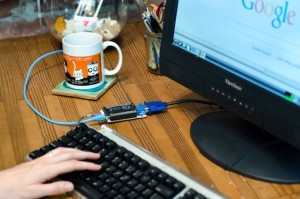
c.h.i.p in action

c.h.i.p in action


From their website:

“C.H.I.P. does computer things. Work in LibreOffice and save your documents to C.H.I.P.’s on board storage. Surf the net and check your e-mail over WiFi. Play video games with a Bluetooth controller. With dozens of applications and tools preinstalled, C.H.I.P. is able to do computer things the moment you power it on!”

casing for CHIP

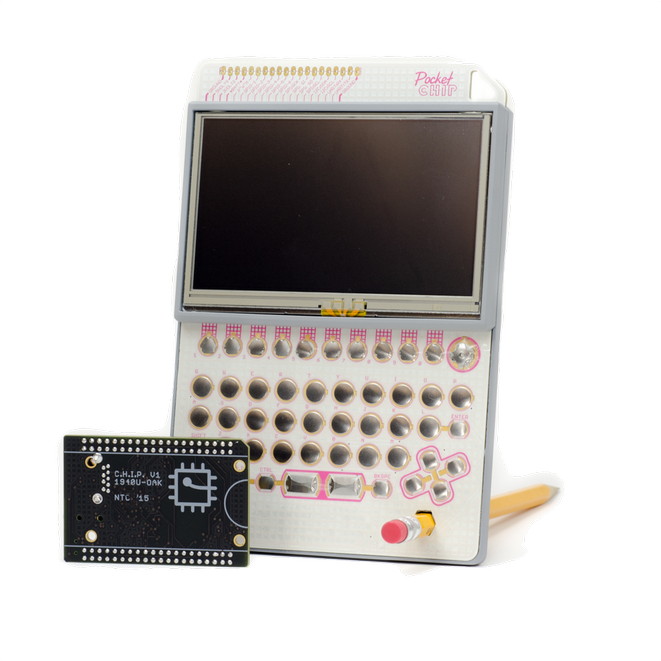
CHIP itself won’t come encased for $9, however Next Thing (also the makers of OTTO) also designed Pocket CHIP, a cute case to hold the CHIP. The $40 device (Kickstarter value) encompasses a full keyboard, 4.3-inch touchscreen and a 3,000-mAh battery which promises 5 hours of battery life.

Pocket CHIP has blown well beyond its preliminary funding goal of $50,000 and raised over two million dollars on Kickstarter. We can’t wait to get our hands on one. Next Thing expects to ship CHIP in December, with the cases and additional adapters arriving in May 2016. Obviously, you’ll have to spend extra cash for the VGA or HDMI adapters or any additional hardware, however we’ll soon be able to purchase a functional computer with a ten dollar bill and get change.

You can visit LaptopsPark if you are looking for the best gaming laptops under $1000.


Click here for cheaper and quality add-ons for the Raspberry Pi from AliExpress


3D Holograms in your home by Holus – A scam?

0

Recently, we posted an article about a new awesome device you can place on your tabletop and make your games three dimensional, called Holus. Unfortunately, it has come to our attention that this might possibly be a very good scam!

holus 3
Holus


Holus has raised more than $250,000 (Canadian) in their Kickstarter campaign. Thanks to Raphael De Courville, we now think that we shouldn’t have posted the original article in the first place, because, it seems that Holus could indeed be a “fraud”, or a better word would be, an alleged “scam”. Read what Raphael researched and wrote. You can read his original article at: Is Holus about to become the most successful scam in the history of Kickstarter?

In their video, the Holus creators (a Vancouver based startup called H+ Technology) are using photorealistic renderings to make their product look like a perfect volumetric display.

Beauty is in the CGI of the beholder


So what about the motion tracking they are showing in the video? H+ says:

It changes the image so we actually get different perspectives. As a result, we have now turned it into a proper hologram.

Using a smartphone orientation sensors to rotate a model in the Holus.

This is a cool trick but don’t be fooled: while the model on the screen is rotated, the image is still a flat plane since both eyes are looking at the same image (of course, this is hard to see in a 2D video).

The Holus is nothing more than a standard computer monitor lying on top of a glass pyramid. In other words, in it’s current form, the Holus is unlikely to display anything more impressive than four distinct 2D views, reflected in four panes of glass. Or as someone on Reddit brilliantly said: “This is a strange 4 sided semi transparent TV.”

H+ Technology said they are exploring using a lenticular display (the same 3D technology used in the Nintendo 3DS for example) but it looks like this is not past the R&D phase yet. Even if Holus did show a prototype that solved the many issues of lenticular displays, it won’t look anything like the promo video simply because reflected light cannot do that.

To read the full article, head over to Raphael’s page.

Holus also (allegedly) created numerous fake accounts on Kickstarter and posted glaringly positive messages in favor of the project. The accounts were just 1 day old!

Another thing that we noticed is that, the website of H+, the creators of Holus, is missing many pages (or has a lot of bad links). Click on Press -> In the news -> 404 error. Try Contact and you’ll be taken here: https://www.hplustech.com/new-folder/ This cannot be expected from true professionals, who by the way are running a ground breaking technology company. Something smells fishy, and it might be Holus…

We contacted H+ Technologies for a response to these allegations, they sent us this link: https://vimeo.com/channels/933372

Related links

Holus: Interactive Tabletop 3D “Holographic” Display

Did Holus scam 200.000$ of Kickstarter backers using a 19th century parlor trick?

Holus: H+ Technology back-pedals in the wake of “holoscam“ backlash

Is Holus about to become the most successful scam in the history of Kickstarter?

H+ Technology’s official website

Holus Kickstarter Campaign

Holus: Interactive Tabletop 3D “Holographic” Display

We haven’t seen Star Wars like holograms in real life, until now that is. A brand new device called the Holus is aiming to change that.

holus scam

Important: Please read our update regarding Holus as well.

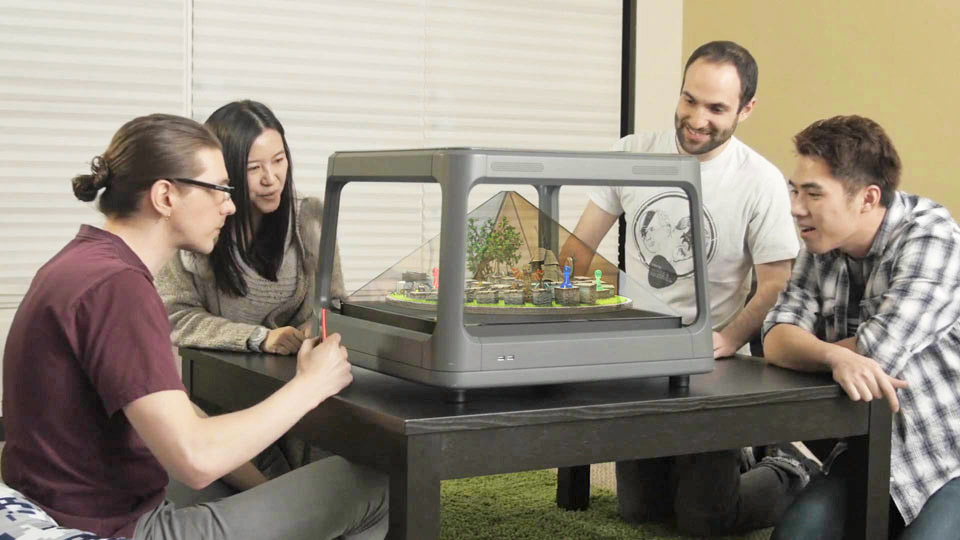
If you have ever thought that the apps and movies in your smart phone have been flat and lifeless, a company called H+ Technology may have a solution. It’s crowdfunding the Holus, a tabletop display that turns 2D content material from many sources into 3D holograms inside a glass pyramid which you can see from any direction. All you need to do is plug it in, after that, you may play digital board games, academic titles and many other types of apps. It is also set to incorporate functionality for eye trackers and even brainwave sensors. There’s even motion tracking that can ensure content follows you whenever you wander around. 

holus buildings

The potential for the machine has already won folks over. It sailed past its initial funding aim of CAD $50,000 for its Kickstarter campaign in only two hours, and at time of writing has attracted greater than $254,873 from backers.

H+ hopes that Holus will revive the lost art of real-life get together with out making you revert to that Ludo game gathering dust in your attic. That’s a bit optimistic, however it’s difficult to deny the appeal of a living room holographic display that you can move around.

The Holus will be available in two varieties, Home and Pro. Home has two smartphone charging docks, whereas Pro contains an HDMI port and comes with an SDK tool, enabling developers to create software programs and apps for it. The company also has plans for upscale versions, having created a room size model to be used at exhibits.

The first delivery is promised around July 2016.

Apple didn’t fix BIG security vulnerability in 6 months!

0

Six college researchers have revealed dangerous zero-day flaws in Apple’s iOS and OS X, claiming it’s entirely possible to crack Apple’s password-storing key chain, break app sandboxes, and bypass its App Store safety checks.

 

apple 0day


A variety of newly found vulnerabilities affecting Apple’s Mac OS X and iOS operating systems may permit attackers to steal passwords and different credentials if successfully exploited. The vulnerabilities were uncovered by a team of researchers based in the University of Indiana, who found that the 4 separate flaws could enable a malicious app to bypass safety controls and steal sensitive information from different apps. The vulnerabilities had been reported to Apple in October 2014 and the company stated it will require six months to roll out fixes. Although some issues have been addressed, a lot of the vulnerabilities remain un patched till the filing of this report.

Every app installed via Apple’s Mac App Store and iOS App Store is confined to a secure container on the pc generally known as a sandbox. These apps are granted restricted privileges and if they need to access any extra resources outside of their very own container, then the user must grant permission first. The researchers discovered 4 vulnerabilities by which unauthorized access could possibly be granted, which they refer to as cross-app resource access (XARA) attacks.

1. Password-stealing vulnerability
Apple operating systems have a safe password storage feature referred to as Key chain which permits the user to store and retrieve passwords for numerous apps and on-line services. The first vulnerability permits a malicious app to create a key chain entry for another app. If the targeted app isn’t present on the pc and the user subsequently installs the app, its credentials are saved on the key chain entry created by the malicious app. If the targeted app is already installed, a malicious app can delete its existing key chain entry and create a brand new one, which the user will re-enter their credentials the subsequent time they access the targeted app.

chains broken

2. Container cracking
The second vulnerability could enable a malicious app to gain entry to the secure container belonging to another app and steal data from it. Each app container is given a unique id referred to as a Bundle ID (BID). The Mac App Store doesn’t permit submitted apps to make use of a BID that’s already been utilized by any another app. 

However, an issue lies with sub-targets, apps that work embedded in another app, such as extensions, frameworks, or helper applications. The Mac App Store doesn’t verify if a sub-target’s BID is similar to those belonging to other apps or their sub-targets. An attacker might therefore use a malicious app with sub-targets that use BIDs belonging to other apps or their sub-targets. This may allow the malicious app to gain full entry to another app’s container. 

3. Inter-process communication (IPC) interception
An additional vulnerability exists  as a result of cross-app IPC channels on Mac OS X and other platforms, such as Web Socket, which contain flaws which expose vital data. For instance, Web Socket is used to establish a connection between a server and a client. A malicious app might claim the port utilized by a legitimate application and intercept data supposed for it, for example passwords or other sensitive data. 

4. Scheme hijacking
The 4th vulnerability relates to the URL scheme apps used to pass information to another app. For example, URLs starting with “mailto” direct information to the Mail app. This vulnerability permits a malicious app to hijack a scheme, which implies data sent to the target app can be obtained by it instead. This may facilitate the theft of access tokens and other data. 

Risk of exploitation
All apps distributed on the official Mac App Store and iOS App Stores are vetted by Apple and only sand boxed apps may be distributed. A Mac OS X feature known as Gatekeeper blocks apps that aren’t signed by the Apple Store or a trusted developer.

However, the researchers created a proof-of-concept malicious app which passed the vetting and was briefly live on the Mac App Store before they removed it from the store.

Here’s the boffins’ (the security guys) description of their work:

Our study brings to light a series of unexpected, security-critical flaws that can be exploited to circumvent Apple’s isolation protection and its App Store’s security vetting. The consequences of such attacks are devastating, leading to complete disclosure of the most sensitive user information (e.g., passwords) to a malicious app even when it is sand-boxed.

Such findings, which we believe are just a tip of the iceberg, will certainly inspire the follow-up research on other XARA hazards across platforms. Most importantly, the new understanding about the fundamental cause of the problem is invaluable to the development of better app isolation protection for future OSes.

In-depth technical details are available in the aforementioned link.


No known exploits of those vulnerabilities have occurred within the wild. However, as word spreads of their existence, we believe its highly likely that attackers will begin making an attempt to exploit them.